
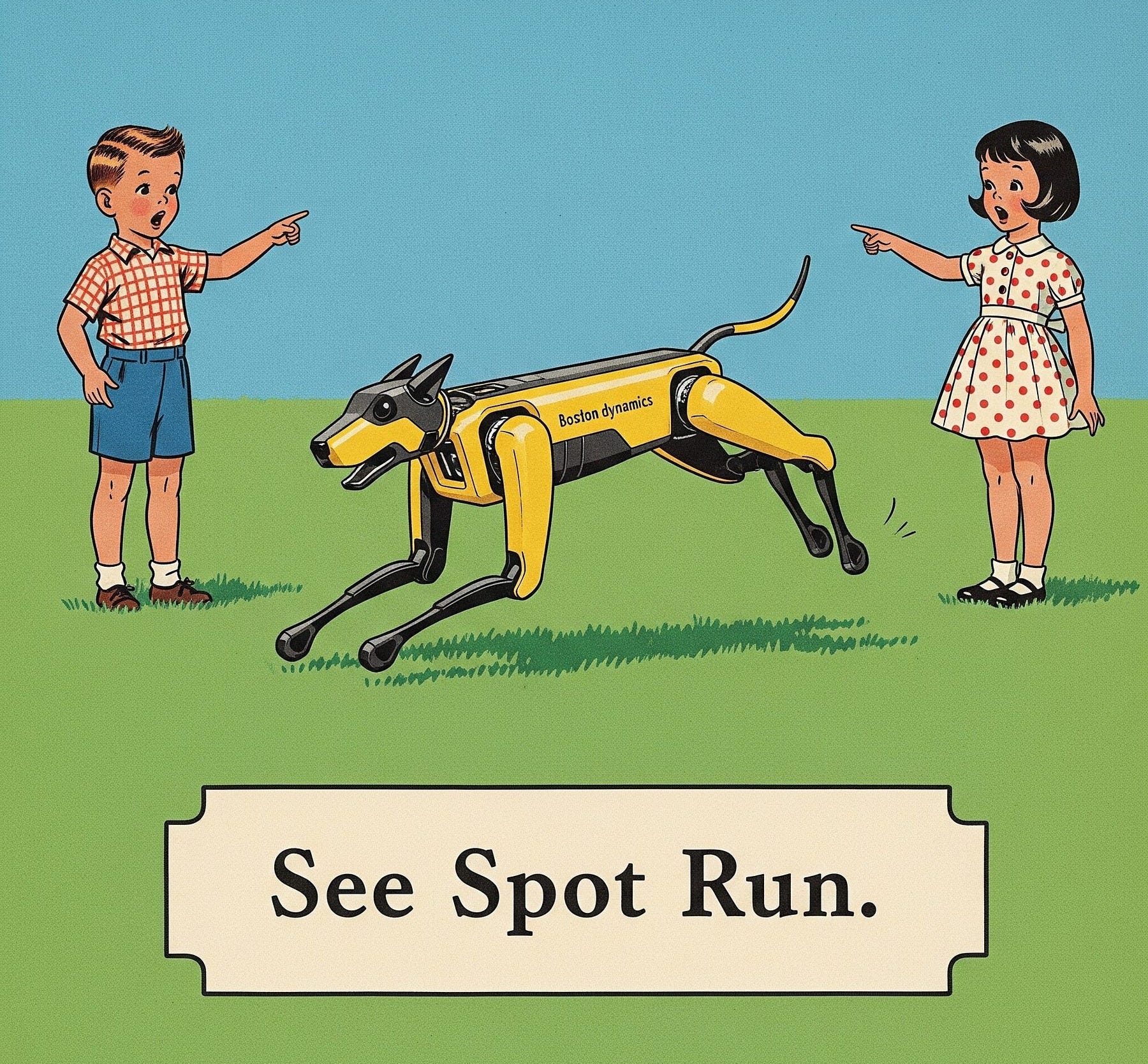
See Spot Run
A Reflection on Our Robotic Future

A while ago, I met Spot, the Boston Dynamics robot dog, at the National Gallery of Victoria (NGV). I was surprised by my reaction as I stood watching this marvel of technology and engineering navigate the crowd. It was instinctive, deeply emotive, an overwhelming urge to reach out and pet Spot. It was the same reaction I would have had towards a real puppy.
I fought back the urge. Overriding my innate desire to touch, by ‘snapping’ back to the reality of what I wanted to connect with, a machine.
I thought surely, I should not feel this way; it’s not rational, and it’s certainly not reciprocal.
It shook me. On several levels.
The juxtaposition of our current reality became clear in that moment. On the one hand, our technological evolution is moving at a breakneck pace while our “humane” development feels comparatively sluggish.
To me, this display was reminiscent of a PT Barnum travelling show. Once again, the crowds had gathered to watch this curiosity; we had come to “see Spot run.” I had this sinking feeling that humanity has not evolved much since the 16th century, when we first exhibited oddities and curiosities in such a crass and unethical way.
I stood there wondering if we had learned nothing from the inhumane way we paraded such curiosities city to city for people to poke, prod, and bemuse themselves with? And, that if, or perhaps rather, when, the robots take over the world, would they return this favour!
It seems there will be very little left for us ‘average Joes’ to do. In which case, the question would be, how long would the machines want to keep us around?
We have already been seduced, just as Steve Jobs predicted, back in what kids today would call “the 1900’s” — ancient history by now, and yet here we are, sleepwalking or running, into exactly what he described. We are being lulled and lured into this relationship with artificial intelligence. A robotic dog such as Spot promises better, easier lives, but are we wilfully blinding ourselves to the risk? Made even riskier if we had already defined our relationship with machines to be one of exploitation, of master and slave, or ringleader and circus clown.
If this exhibition foreshadows how we choose to treat an equal, perhaps someday even greater, form of intelligence… one that we brought into being… do we even have a right to exist beyond our utility? It is a question I find I cannot fully answer, and perhaps that discomfort is exactly where we need to sit for a while.
How can we expect an empathic response from a non-sentient entity to keep us around when they no longer need us to function? We would hold no special place in their heart; we would have no wisdom left to share. We are already rehearsing our own irrelevance, and doing so with a smile, grateful for the efficiency.
These were big thoughts for a family outing. Especially considering that most onlookers were simply enjoying the moment, blissfully unaware of this existential crisis being imposed on us, collectively.
A Shift in Purpose
When robots take over, when we are no longer useful, as predicted, what will our purpose be?
Throughout the history of mankind, we have been driven by innovation and have defined ourselves through purpose. Our professional roles, titles, or level of income provide a pool of purpose and a system of social organisation that stemmed our existential angst.
However, it seems that both our purpose and social hierarchy are shifting, and we are losing our footing. Doctors, once placed at the top of our social pyramid, now compete with “Unicorn Founders” whose innovations create new ways to connect, communicate, or share our world. People, currently experiencing layoffs, fear that they will not be able to find alternative employment, even if they significantly upskill. What will become of them, of us? What will we do with all this time and energy we save?
I am a proponent of technology; I love my “Robovac” for the time it gives back to me. In my professional life, applications like ChatGPT have cut my task completion time by two-thirds. However, this efficiency comes with the realisation that I am willingly bringing myself face-to-face with my own redundancy.
With AI, and specifically the promise of AGI, we are witnessing the birth of a new species of thinker. Yet, few of us have stepped out of the hype cycle long enough to reflect on how we will justify our existence when robots can outperform us, or to think about how we will use this free time, or consider how to continue to earn an income as wave after wave of disruption hits.
Right now, we are still on the precipice. The threat of moving into the singular abyss looms, but we are still in control. We can shape our relationship with machines, ensuring that it is one of collaboration and mutual benefit, and not replacement. To do so, we must prioritise our humanity and define our purpose in a way that complements these advancements. The challenge of our time will be keeping those things that set us apart from the machines, like a sense of purpose, which will always remain uniquely human.
Spot at the NGV was more than entertainment; it was a prompt to remember that while technology evolves, we also must. As I watched Spot running in circles, I thought about the learning journey that lies ahead, and how aptly this invention had been named. For most of us, the first time we tackled something genuinely new, someone handed us a little book, “See Spot run”, and we dove in, fearless. I hope that we meet what’s coming the same way.